Understanding the Atomic Mission: A family's connection to the B-29 that dropped the first atomic bomb.

Updated: Jan 2
In the summer of 1945, the United States still faced a potential protracted fight in the Pacific theater. The military and the government and the American public were weary of the enormous costs of the war, both in lives and money, but without decisive action by the Allies, the war with Japan was potentially far from over.
Throughout the spring and summer, Allied forces continued to fight in the Philippines and Okinawa and conduct bombing raids on the Japanese mainland. A land invasion of Japan seemed all but certain and it was projected to be very costly in resources and casualties. (About half a million Purple Heart medals were made in anticipation of the invasion and that stockpile was used to issue the medals to combat wounded well beyond 9/11.) Ultimately, the unprecedented decision to use the world's first atomic bomb was made in an effort to hasten the end the war once and for all. The highly secret plans to deploy the first atomic bomb were underway. Nobody knew exactly what would happen, but the experts agreed that something large would most certainly happen.
You can't study WWII (or any aspect of US or military history) without knowing a little bit about the only use of atomic weapons in history. I'm also an aviation fan, so the whole story behind the men and the plane (a B-29 Superfortress) that pulled this off always intrigued me...so much so that I eventually flew in one in 2021, in the bombardier's seat up front, because I wanted to visualize as much as possible what it was like.
For the drop of the first atomic bomb on Hiroshima on August 5, 1945, the plane was the Enola Gay and crew members included Colonel Paul W. Tibbets, Jr., the pilot, Captain Robert A. Lewis, co-pilot, Captain Theodore "Dutch" Van Kirk, navigator, and Major Thomas Ferrebee, bombardier. Additionally, and because I don't leave anyone behind, here's the rest of the 12-man crew: Captain William S. "Deak" Parsons, Navy, weaponeer and mission commander; 1LT Jacob Beser, radar countermeasures; 2LT Morris R. Jeppson, assistant weaponeer; S/SGT Robert "Bob" Caron, tail gunner; S/SGT Wyatt E. Duzenbury, flight engineer; SGT Joe S. Stiborik, radar; SGT Robert H. Shumard, assistant flight engineer; and PFC Richard H. Nelson, radio operator.
Our man of interest here is Tom Ferrebee because - fun fact - he was the one flying the plane when he dropped the bomb. That was SOP so the bombardier could keep the aircraft on its target run as much as possible. I knew this. But my close friend, Elizabeth, of Washington, DC, and her family (from North Carolina) did not. Elizabeth and her mom are related to Tom. After watching Masters of the Air, Elizabeth and her family wanted to know more about what Tom did and what it must have been like and what he knew before and during the mission (not much for security reasons and because it was an untested weapon). She told me that her mom and dad were going to visit her in DC, largely for the purpose of going to the Udvar-Hazy Center of the Smithsonian's Air and Space Museum to see the Enola Gay in person. She asked if I would meet them there to shed light on the whole thing. All I needed to know was the date and time!

We all thought we were going to be at Udvar-Hazy for maybe a couple of hours. We were there for most of the day...a really good day. We spent a large portion of it on the catwalks at and overlooking the Enola Gay. It was eye opening for them and for me in that I got to see the beautiful curiosity and pride burst forth from them as we all learned more about the aircraft and the crew than we knew previously. It was also a distinct pleasure to be able to describe - even a little - what it was like inside a B-29 while in flight. And, of course, from balloons to spaceships, the Udvar-Hazy has it all. The Enola Gay was the main attraction for us, but not the only one.

The family's gratitude was profound. It was an unforgettable experience. Plus, it was one of the first times that I was able to help a family understand what their WWII veteran did outside of archival research. And it was my honor, of course, to do that while also perpetuating Ferrebee's story. Mission accomplished and we still talk about it today.
*****
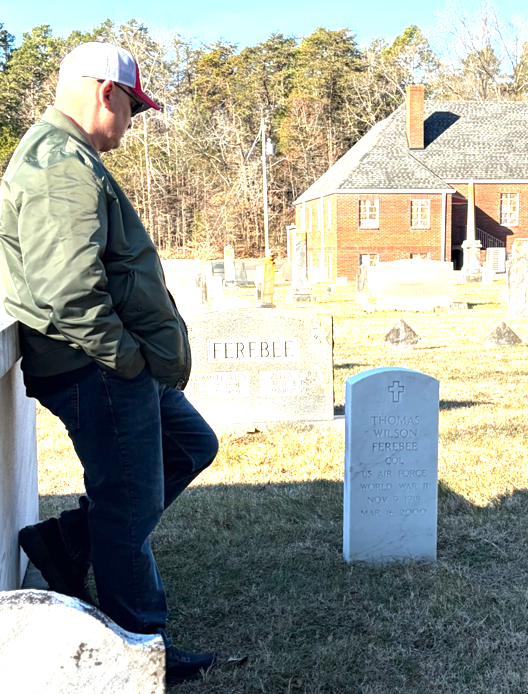
These stories resonate. Sometimes they just linger in the back of the mind, quietly reminding us that while it is good that they get grand attention on occasion, that lone occasion or two should not be all. A couple of years after our trip to Udvar-Hazy, just before Christmas of 2025, on a chilly and quiet morning, we made the trek to a small church's graveyard in North Carolina that most folks would just drive right on past without giving any thought to who is buried there...