
Wartime History of Bill Tobitsch and the USS Croatan (Navy, Enlisted, Atlantic)

Updated: Mar 4
A neighbor and friend of mine talked to me in the fall of 2025 about his grandfather, Bill "Willie" Tobitsch, a sailor in WWII. Bill was from Butler, PA, but moved to the Bronx and entered the Navy there. The family already knew some of what Bill did in the Navy, by Bill's own admission. Further, to this day, the family has Bill's shadow box. So, I was not starting from scratch with Bill and there was no big void in knowledge that I was trying to shine light in. Nonetheless, the questions were these: what don't we know? Did Bill do more during the war than he talked about? If so, is his story worth telling? Answers: Quiet a bit, yes, and absolutely.
Also, a few years back, the Tobitsch family celebrated the wonderful love affair between Bill and his wife, Agnes, by creating a book of memories about them as an instant family heirloom. It's great little read, very heartwarming, and falls under the category of 'you can't make this stuff up' because it's such a great look at how one family represents Americana. It discusses Bill and Agnes when they were young, their meeting and eventual marriage, and the family they created after the war and the life they lived. I was entrusted with this book for a few weeks while I was gathering materials for this story, which is what I call an addendum to what the family already knows. You see, while the narrative of Bill's experience in the Navy in WWII is minimal in the book, there are several photos of him while in the Navy. The photos of him and Agnes in which he is wearing his uniform testify to impact of his service on him and the young woman he was madly in love with. That's what I hoped to help the family understand more than anything. Beyond that, any other information was a bonus.
The Tobitsch family granted me permission to tell this story here, and, as always, my gratitude for being allowed this honor is beyond words. And this was such a fun story to investigate. Bill and his shipmates performed every seaborne operation I know of aboard the USS Croatan, a baby aircraft carrier. Plus, Bill had the most important job in the Navy! I'll get to that in a bit, but for now let's set the tone with one of the most beautiful wartime photos I've ever seen...

Bill's Enlistment
Bill enlisted in the Navy on May 11, 1943, just shy of this 23rd birthday. By his own admission, he enlisted because the draft was coming and he chose the Navy but did not explain why. However, now knowing a little bit about him, he was fond of watercraft and helped build ships before enlisting. It is not a stretch to think that ship building was a welcome challenge to his inventive mind, productive hands, and problem-solving skills. He could put all those things to effective use in the Navy, and the Navy certainly had a need for people like Bill.
In the book about Bill and Agnes, he is quoted as saying: “I served 30 months in the Atlantic chasing German U-boats…” This massive understatement on his service deserves a chuckle because one, that’s two-and-a-half years at sea (with some shore leaves). Two, that’s while on a warship that was involved in warfighting. Three, ship duty is hard. Four, the type of ship he was on and the different missions it performed are worthy of heroic tales in and of themselves. Five, Bill was a repairman, a fix-it man, and likely a jack of most trades. He was officially a Carpenter in a ship’s Construction and Repair section. What he didn’t know how to fix, he problem-solved until he and his shipmates did. Six, he was away from his girl. Seven, well, we get the point. Bill’s service during the war was hard, valuable, important, and difficult for more reasons than we will ever know because he was a sailor at war, on a warship, taking war to the enemy while undergoing those inherent risks.
Bill's Ship: the USS Croatan
The Croatan's story is the story of every sailor aboard her. The USS Croatan (CVE-25, CVE meaning Escort Carrier) was in the Bogue class. It was built in Seattle and commissioned in April 1943. This ship, and the others like her, was specifically designed and deployed in WWII to support naval operations with air cover and fighter support. ‘Carrier’ of course means aircraft carrier, although the Croatan was considered a ‘baby carrier.’ These baby carriers could be built faster and in more numbers than the traditional larger carriers and they filled a vital role between those and other surface ships. Additionally, speaking to the need for inventive and able men like Bill, some of these baby carriers, including the Croatan, had cement hulls and therefore the nickname Kaiser Coffin...they required problem solving in maintenance and repairs the likes of which had never been seen before. Further, many of these ships were not blueprinted as carriers from the keel up. They were based on commercial vessels to the first deck, then the ‘flattop’ and the necessary superstructure and infrastructure that supported it were essentially welded on top of the ship. All of this is to say that the Navy and each ship’s crew had to figure out these types of boats as they went along, to include how to repair many things from scratch. Therefore, in thinking of just the ship itself in this light, Bill’s work on it was critically important.

The Croatan at War
Croatan arrived at Norfolk, VA, in July 1943. On August 5, 1943, she sailed for the North Atlantic as the nucleus of a hunter-killer group to conduct antisubmarine actions to protect the many convoys sailing to the UK and beyond that to a port in the north-western Soviet Union. During these operations, two of her planes engaged with surfaced German submarines. Additionally, the new tactic of conducting flight operations at night was tested and proven on the Croatan. Conducting flight operations on aircraft carriers is an extremely dangerous endeavor during the day in perfect weather and on a calm sea. At night, in war, well…one can only imagine the chaos and peril. The Croatan returned to Norfolk in late September. This tour lasted almost two months.

From mid-October to the end of December in 1943, Croatan made two voyages to Casablanca to ferry aircraft and plane crews there for the ongoing shipment of war materials and men across North Africa in support of the campaigns for Sicily and Italy. Below is a photo of Bill and some his shipmates in Casablanca. Even though the photo is a bit blurry, you can make out Bill and his crooked smile at the top-left. It is good that he and his shipmates had some time for liberty on shore and got to spend some time in the local culture and populace, as it were. If nothing else, Casablanca was an interesting juxtaposition of a large ancient city that had been overrun with the bustling modern US military. For a kid raised in the Bronx, this brief time in Casablanca was likely the stuff of dreams!

For the first couple of months in 1944 the Croatan notched two more antisubmarine patrols and then participated for a brief time in tests (likely radar identification) just offshore at the Naval Research Laboratory just south of Annapolis, MD.

Antisubmarine patrols were resumed in March and May 1944. On April 7, her planes identified a German submarine, ‘painted’ its location, and it was promptly sunk by two of her escort ships. Later that month another German submarine was destroyed in the same way. Her June and July patrols yielded similar results – two more German submarines were destroyed, one of them by a net of depth charges deployed from the Croatan and three of her destroyer escorts. Another German submarine was tracked by Croatan’s aircraft until the submarine surfaced, and that U-boat’s days were over. There were 60 survivors, including the sub’s Commanding Officer, and all of these men were rescued by Croatan and the destroyers. (Note: The German Navy rarely, if ever, rescued enemy sailors. The US Navy holds itself to a higher code and always has.)


Croatan went through another series of tests near Annapolis and was put back in action in August of 1944. In September she aided survivors of a Navy destroyer that eventually succumbed to a hurricane off the coast of Florida. In October of 1944, the Croatan underwent antisubmarine training in between Cuba and Bermuda before being assigned as cover for an east-bound task force.
The Croatan stopped in New York in February of 1945, much to Bill's pleasant approval, no doubt, especially since he and Agness got engaged while the ship was in port!
The Croatan was used as a training carrier to certify pilots in carrier operations for about a month then returned to Norfolk briefly before being assigned to join a barrier line off of the northern part of the US’s eastern seaboard. Two more German submarines were sunk by ships under Croatan’s influence, bringing her known total destroyed to seven. In May of 1945 she returned to New York – home again for Bill! – for overhaul.

In fall of 1945 the Croatan qualified more aviators in carrier operations then at about Thanksgiving the Croatan made two trips to and from France to bring troops home. This mission, without doubt, was the most significant one for everyone on board, crew and passengers!
Shortly after that, the Croatan had no further significant actions or duties related to WWII. All missions were accomplished, and then some. For a ship and its crew, this is a matter of immense pride. This was especially true for crew members that were part of a ship’s first complement, like Bill. From start to finish, he was there.

The Most Important Job in the Navy!
Bill had the most important job on the ship, perhaps the most important job in the Navy: he was in charge of keeping the Croatan’s soft serve ice cream machine up and running! He mentioned this in jest in the family book, but this was actually important. The Navy banned alcohol on ships in 1914. Sailors (and soldiers) traditionally operated on caffeine and nicotine and consumed alcohol while not on duty. All three of these habits were important for morale and productivity. When alcohol was not available, a replacement had to be found. Ice cream was it. This was so important that no less than Secretary of the Navy James Forrestal made the distribution of ice cream one of his highest priorities. A whole fleet of ice cream ships was built and deployed to deliver it to as many Navy vessels as possible but if there was an ice cream maker on a ship, it was as important as any other equipment, perhaps more so…
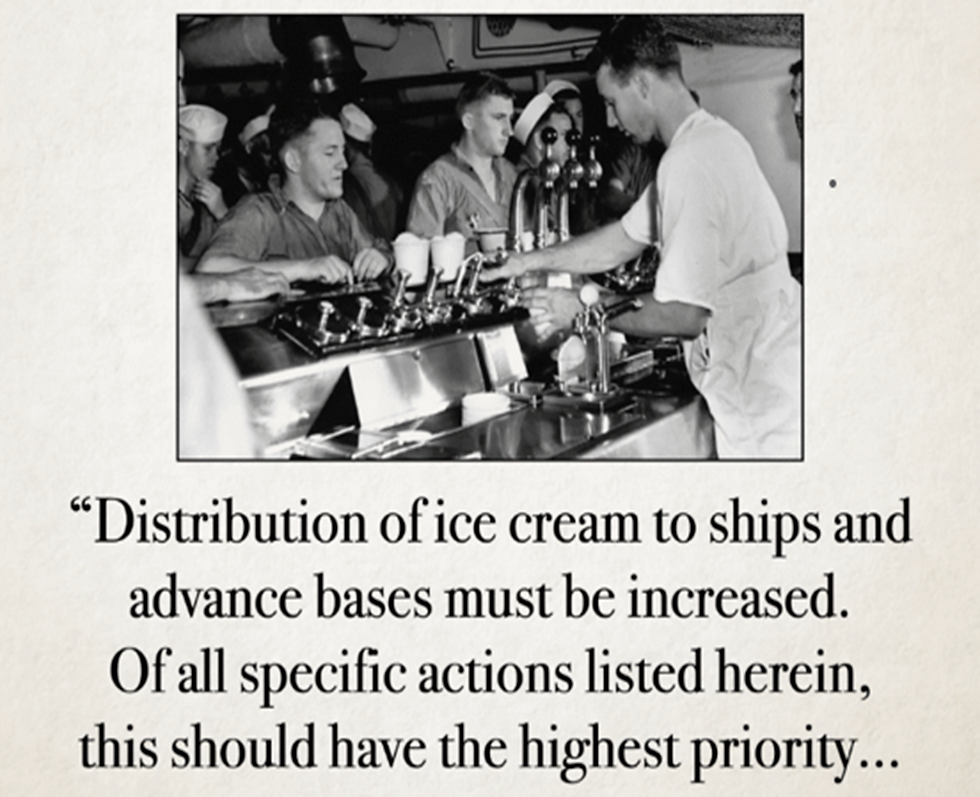
This quote on the matter is more reliable:
“Secretary of the Navy James Forrestal gave the distribution of ice cream ‘highest priority’ after an assistant reported: ‘Ice cream in my opinion has been the most neglected of all the important morale factors.’"
(Anne Cooper Funderburg, Chocolate, Strawberry, and Vanilla: A History of American Ice Cream [Bowling Green State University Popular Press, 1995], 143.)

Conclusion
The wartime history of the Croatan is Bill’s history and that of each of her crew.
Ships are small, contained, and isolated. They wage war and they get shot at. Additionally, in the North Atlantic in WWII, everything that floated was a target of the Nazi submarine ‘wolf packs.’ Every sailor’s and passenger’s fear of Germany’s underwater wolves was not paranoia, it was legitimate, 24 hours a day, every day. It was in this environment, and in the nearly insufferable conditions of living and working on such a vessel at sea, that Bill worked like he did for almost two and half years. He was likely exhausted most of the time – think about it – and when there was actual free time not spent catching up on sleep, there was nowhere to go and practically nothing to do.
Nonetheless, during all of this, he fell more and more in love with Agnes and she with him. When you put Bill’s service and the romance with Agnes together in the throes of World War II, along with just about every possible mission that a ship could complete in war, and their separation for most of that time, it is no wonder that their love was such as it was: strong and everlasting. It was built on a war-induced worry-filled foundation at best but, once it survived that, their love could not falter. It’s no wonder they were inseparable. It’s no wonder they are so fondly remembered. And, for Agnes, and the family, it should be no surprise that Bill was as a good a sailor as he was a man.
Given the opportunity, I would have loved to have spent some time with Bill, perhaps tinkering with something or having him help me fix something that I would not have figured out on my own. And during that, I would have listened gladly to his tales about his time in the Navy. And, of course, after he fixed what I broke, we'd kick back and swap war stories with a beer and - - - - - a bowl of cold and delicious soft serve ice cream.

![Wartime History of Joseph C. Feola (Army, Enlisted, Crew Chief [Aerial Engineer] on a C-47, China-Burma-India).](https://static.wixstatic.com/media/927f97_45003e5447c24612a0fc4001c5f4c2ab~mv2.png/v1/fill/w_975,h_1142,al_c,q_90,enc_avif,quality_auto/927f97_45003e5447c24612a0fc4001c5f4c2ab~mv2.png)

