
Wartime History of Glenn Wible (Army, Infantry, Enlisted, Liberator)

Updated: Mar 4
Note: this history was supplemented by the availability of Army 'morning reports' on the web and a well researched and assembled history of Glenn's unit by private individuals, also available on the web.

Glenn was from Wilkinsburg. His house is long gone. Prior to being drafted, he was working as a foreman at Mine Safety Appliances. He was 24 when he got drafted in the Army, for the Infantry. He was in for just shy of two years from December 1943 to December 1945. There are two remarkable things about Glenn we'll discuss here: one, Glenn was in five campaigns. Two, well, we'll save the heartwarming personal note for last.

Note: The European-African-Middle Eastern Campaign Medal (EAME for short) is awarded a Bronze Service Star, or campaign star, for each campaign the GI was in. Glenn was in five campaigns. Being in five campaigns was so rare that commercial medal builders do not even have an option of adding five campaign stars to the EAME medal. The best illustration of it with five stars could only be found on the medal’s ribbon, not the medal itself, in the form of a family’s remnant. Here’s what it looks like:
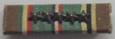
Glenn was in A Company, 1st Battalion, 331st Infantry Regiment, 83rd Infantry Division.

At the end of basic training and Infantry training, Glenn was sent to England for additional training before arriving in France mere days after D-Day, on June 22, 1944, via Omaha Beach. Shortly after that, in heavy and close fighting with the Germans in the hedgerows in the Brittany region, Glenn was shot in the leg, thus earning his Purple Heart. The 83rd ID experienced over 200 days of combat.

Remember that Glenn and his fellow soldiers were in five campaigns:
Normandy Campaign. June 6 to July 24, 1944. This was the invasion and succeeded because the Germans withdrew to central France.
Northern France Campaign. August 5 to September 14, 1944. While an overall success because the Germans were driven out of Northern France, Allied offenses stalled.
Rhineland Campaign. September 15, 1944, to March 21, 1945. Victory for the Allies. Germany retreated across the Rhine River as they pulled back closer to home.
Ardennes-Alsace Campaign. December 16, 1944, to January 25, 1945. Victory for the Allies as the last considerable German offensive is driven back. The Battle of the Bulge was the main event in this campaign. The Battle of the Bulge was a cold, terrible, bloody affair.
Central Europe. March 22 to May 11, 1945. Victory for the Allies. This was the last campaign. Germany’s surrender.
The only job of the Infantry is to engage the enemy directly. To earn a Combat Infantry Badge is to have come under fire while an Infantryman. The Badge is known the world over and is held in very high esteem. It is indicative of performance as a true warrior at the very essence of everything that war embodies. It can be safely assumed that Glenn experienced the absolute worst ground warfare in France, the Low Countries, and Germany. They traveled 1,400 miles in Europe and fought during most of it. They had periods of rest, of course, and additional training behind the lines, but by and large it was a life of little comfort, much activity, and copious amounts of danger and killing. This is true-blue-American-hero kind of stuff.
Further, Glenn was 'only' a Private First Class when he got out of the service, meaning that he got promoted 'only' twice. I use the single quotes to indicate something important: the fact that any GI did not get promoted multiple times during their service means nothing. Glenn was one of the tens of thousands who did their jobs exceedingly well, day-in and day-out, for sometimes up to four years. They were where the rubber hit the road, working where it mattered most, in all matters of conditions and combat, and often it just didn't matter if they got promoted or not. These were the soldiers who were incredibly reliable, always, and they embodied the ideal that it is just as important to be a good follower as it is to be a good leader.
Additionally, Glenn was a Liberator. When his unit drove through the main gate of the Langenstein camp, camp guards were cowardly fleeing out the back gate.


Like so many, Glenn came home and went on to live as good as life as he possibly could, considering the undeniable lingering challenges he faced due to his service, to one degree or another.
I was fortunate enough to talk Glenn's son (Glenn) at length. Again, Glenn (the GI) was one of the many that I would have gladly served with, fought with, and raised a glass with after the war. Of all the cool things I learned about him, and all the poignant bits and pieces, this one is the best:
Glenn the son distinctly remembers, like it was yesterday, when his dad got home. He remembers with perfect clarity this event, 80 Decembers ago, when his dad literally ran to him, hugged him fiercely and lovingly, and therefore accomplished his last and most important mission of the war...coming home to his boy.
I salute them both with honor.
![Wartime History of Joseph C. Feola (Army, Enlisted, Crew Chief [Aerial Engineer] on a C-47, China-Burma-India).](https://static.wixstatic.com/media/927f97_45003e5447c24612a0fc4001c5f4c2ab~mv2.png/v1/fill/w_975,h_1142,al_c,q_90,enc_avif,quality_auto/927f97_45003e5447c24612a0fc4001c5f4c2ab~mv2.png)

