
Wartime History of Joseph C. Feola (Army, Enlisted, Crew Chief [Aerial Engineer] on a C-47, China-Burma-India).

Updated: Apr 1

Distinguished Flying Cross with one Oak Leaf Cluster indicating two awards of the medal; Air Medal with one Oak Leaf Cluster indicating two awards of the medal; Good Conduct Medal; American Campaign Medal; Asiatic Pacific Campaign Medal with three bronze service stars indicating service in these campaigns: India-Burma, China Defensive, and China Offensive; World War II Victory Medal.


Let's get right to it: Joe was as much an aviation stud as any pilot ever was, perhaps more so. Joe achieved the rank of Technical Sergeant/E-7 in less than three years and as a Crew Chief in CBI was responsible for at least one aircraft, the work of its enlisted crew members, and the execution of numerous missions involving aerial supply drops, search and rescue, and early special operations. He likely worked pretty much all the time...even while pilots were getting their mandatory rest. And all of this was in India and China, over the Himalayas, during round-the-clock flight operations, and while getting shot at with no way to shoot back. He had at least 600 hours of flight time, hence the second award of his DFC.
Overview
Joe was from Brooklyn.
He worked at Tidewater Terminal Transportation.
He was married and they had a young son.
He was 26 when he entered the service.
His dates of active service: August 19, 1942, to June 25, 1945.
Once his unit was assembled, it was deemed competent enough to become a cadre unit that trained other units for their overseas deployment, even though Joe's unit had not been deployed. Therefore, for over a year, Joe was stateside. After that, his unit, the 27th Troop Carrier Squadron, was deployed to India.
Once there, the 27th conducted flight operations in support of the Chinese and some Allied forces that were trying to undo Japan's spread and influence in the region. The 27th's early operations were to Burma and it was not long before they flew into China. Later, the 27th was based in China and performed every type of aerial supply they could and eventually conducted search and rescue operations. They were also on the cutting edge of early special operations using fixed-wing aircraft and did some work for the Office of the Strategic Servies (OSS), which was the precursor to the Central Intelligence Agency (CIA). The 27th, late in the war and due to the inevitable re-shuffling of headquarters organizations, became part of the Flying Tigers.
The Work
Crew Chiefs were responsible for their assigned airplane to be ready to fly at all times. Getting a plane ready for a mission was an arduous task due to the numerous things that had to be checked and, as an example, the difficulty in starting the engines…each prop had to be turned 14 times to drain oil from the engine’s cylinders.
Crew Chiefs also stood in the back-center of the cockpit during take-off and landing to read the instruments and intercept any mechanical difficulty.
Source for above: C-47 Crew Chief's Four Flights into Hell - Warfare History Network
Crew Chiefs were also responsible for any and all cargo, be it live or inanimate, on every flight. They had to calculate the weight of the cargo and its distribution in the plane so as not to upset the plane's center of gravity…this is called weight and balance and is not easy to figure out.
Planes did not fly unless the Crew Chief said it was OK. Pilots and co-pilots deferred to their Chiefs, always. Crew Chiefs were also usually in charge of the mechanics who worked on the planes and, of course, the Chiefs had to know almost everything their mechanics did. Crew Chiefs, when warranted, also flew planes for brief periods of time. In aviation, Crew Chiefs are the go or no-go guys. Whatever the Crew Chief recommends is what happens.
Pilots and co-pilots were commissioned officers. Crew Chiefs were enlisted – Non-Commissioned Officers – if they held the rank of Corporal and above. This further emphasizes their status as the plane’s boss.
Flights ranged from an hour or two to ten if the weather was bad.
The 27th flew over 6,800 sorties over the worse terrain in the world, in the most vicious weather, in a war zone in which their planes got shot up and sometimes shot down. The 27th received official praise and citations from its command, the Department of War, Great Britain, and Nationalist China.
Source: Collection: 27thTroop Carrier Squadron Foundation papers | Florida State University ArchivesSpace

"The 27th was a C-47 squadron with hard-won experience supporting British irregulars and Allied armies in Burma. Their transfer to the 14th Air Force [Joe’s higher echelon command] in China brought a new dimension to the campaign in southwest China. Supplied from the air, Chinese troops could abandon conventional supply lines. Instead of meeting the well-trained and experienced Japanese head-to-head, they could infiltrate the front, cut-off the Japanese supply, then reduce enemy strongpoints by siege and assault. Difficult terrain and volatile weather made for challenging flying. Nonetheless, the 27th launched a transport every fifteen minutes throughout the daytime to supply the Chinese troops. The aircrew could soon find any drop zone or town, 'as easily as we could find the corner drug store.' By the end of the campaign in January 1945, the squadron had flown 4,952 sorties, delivering over ten thousand tons of supplies."
Source for photo and paragraph above: This Day in 1944 – 27thTroop Carrier Squadron Begins Airdrops on the Salween Front – Daniel Jackson’s Flying Tigers Page
Mules!

"Other theaters had their transportation corps, weapon carriers and the likes, while the forces in the jungles of Burma had their mules. The sure-footed animal gave yeoman effort to the successes of the ground forces moving through the jungles of Burma and to the squadron they gave activity, aroma and urine.
Temporary stalls made with bamboo poles would be installed in the aircraft and after much persuasion the animal would be tethered down for the flight. Once the mule handlers and their animals were aboard the door to the aircraft was locked from the outside and the flight crew, using a small ladder, would enter the aircraft through a baggage compartment on the left front side of the aircraft. The entrance was directly in front of the left engine and should an emergency require bailing out one would jump directly into the path of the left propeller. Thus if the plane was in trouble it would be touch and go for the personnel.
The unit was flying drop missions [while in India] at and behind the front when a radiogram arrived at base giving orders to ground all of the squadron's C-47s. Many different thoughts ran through the minds of the personal of the squadron but none were accurate - or even close to being accurate. It seems that while we were flying the mules to the war effort their urine ran down the gutters in the metal floor and down on to the control cables to the rear of the aircraft thus causing them to rust and corrode. The problem showed up during inspection on the first plane to be flown to Bangalore, India for complete overhaul. Being the only Troop Carrier Squadron involved in the Salween Campaign, the order shut down the complete war effort in West China and East Burma until such time that floorboards could be pulled and cables inspected and treated with anti-corrosion chemicals and special grease applied. This operation was especially tedious and time-consuming for the engineering department and their mechanics, as they proceeded with the unthinkable task of removing all the screws by hand as no air tools were available. With the task completed the squadron went back to work. One can imagine the ruckus it caused at Fourteenth Air Force headquarters when General Chennault was advised that mule urine had shut down the much-needed services of his troop carrier unit. The mules had accomplished what the enemy could not."


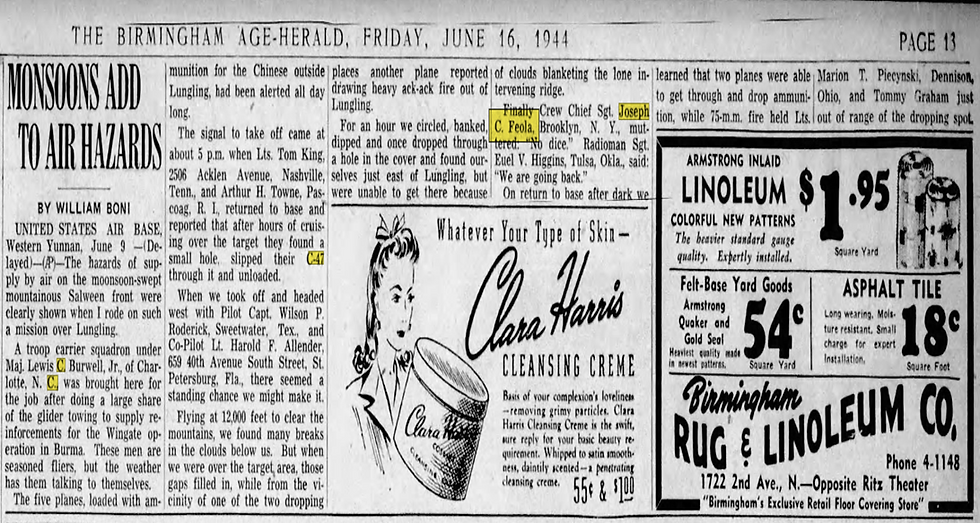
"No dice."
From the 27th's Unit History
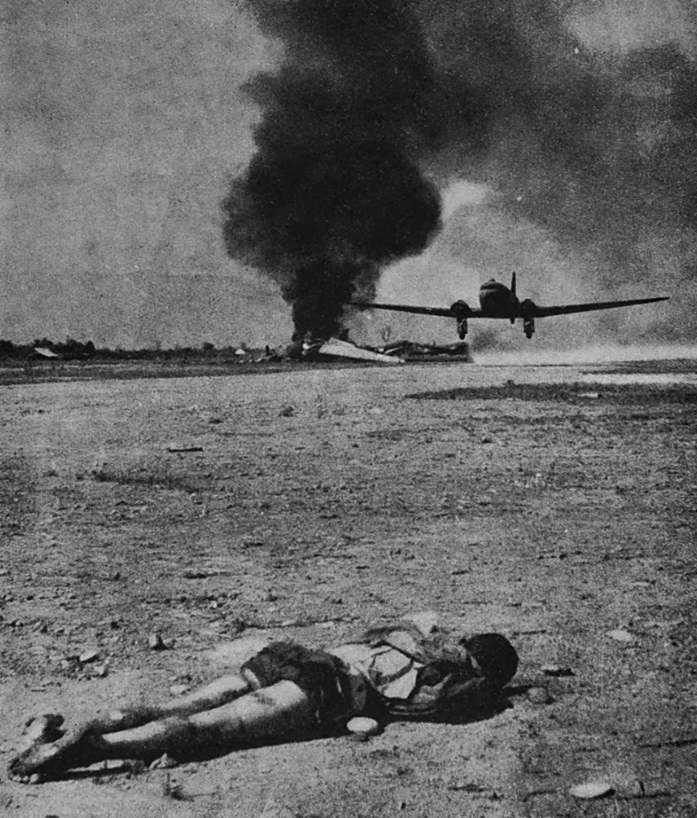


End of section of excerpts from unit history.
Sacrifice and Success - good article by the 27th's Commanding Officer - Operation Thursday
"Operation Thursday" was a daring attempt to interdict the Japanese supply lines in central Burma and cut off the enemy to the north.
In the summer 1943, General Wingate had led a long-range penetration, column overland, behind the Japanese lines which had been moderately successful in harassing the enemy and slowing up his advance through Burma. During this trek he discovered several large savannahs, or jungle clearings, along the Irrawaddy River which bisects Burma from north to south. He reasoned that with proper air support and air supplies he could establish "strongholds" at these areas from which his long-range columns could operate with all supplies, evacuation of wounded, and rotation of personnel being accomplished by air. Roosevelt and Churchill approved.
The tactical and logistical problems implicit in this operation were formidable. Gliders had to be towed in under cover of darkness, since Japanese fighter airfields were all through central Burma. The first several gliders to each target would carry heavily armed infantrymen to counter any enemy resistance. The next several sorties would carry small earth-moving machines to carve out landing strips. Successive waves would bring in men, mules and initial stores of supplies, weapons and ammunition.
On Sunday, March 5,1944, we climbed into our cockpits ready for the take-off. Some 200 pairs of gleaming white nylon tow ropes were strung out on the grass field at Lallaghat, India, behind the nearly 100 C-47 airplanes. Each tow plane was to pull two gliders, each nearly as large as the mother ship, and loaded to gunwales. Although we had practiced towing two empty gliders, these were loaded to a gross weight of 16,000 pounds each. No one really knew whether the contraption would fly, much less clear the 8,000-foot Chin Hills to the east. The Douglas designers had limited the weight of this airplane to 26,900 pounds, all up. This was a total facing us of nearly 50,000…this was a flying nightmare for everyone, but most of all for Crew Chiefs. At full take-off power the engines roared and the ship shuddered a moment and the wheels slid a little in the grass. Finally, it moved and we gathered speed. Just before the jungle rushed to meet us the ship staggered off. The gliders had flown first. We had to make six orbits over the field to gain enough altitude to clear the mountains, and head east, on course.
Intel revealed that the Japs had discovered our plan and were going to force all traffic into Broadway some 50 miles to the north, where a welcoming party would be waiting. Anyway, the decision was "All flights into Broadway."
We lived a hundred years and died a thousand deaths on that 250-mile flight in the darkness to an unknown, and perhaps an unrecognizable destination. At the power settings necessary to maintain 90 miles an hour, fuel gauges were winding down at an alarming rate, and the engines were heating badly due to the excess power and lack of cooling slip stream. Then there were several patches of turbulence which caused the gliders to wallow badly. Controlling the airplane was quite a problem.
Finally, after what seemed an eternity, we spotted the Irrawaddy, turned north for 10 minutes and then saw a clearing in the moonlight that we hoped was "Broadway." There were no lights in the air nor on the ground nor any radio communications. We were 250 miles behind enemy lines. We had burned two-thirds of our fuel going half the distance.
We landed back at Lallaghat with 40 gallons of fuel in the tanks and 30 gallons of sweat in the cockpit. Being the first ship back, the moment we had cleared the runway and cut the engines, General Old jumped on board for a report. We told him that the double tow was murder and that we were going to lose a lot of gliders and men. From that point on all was single tow. Sadly our prophecy was true. A lot of brave men went down with their gliders in the jungle.
In retrospect though, the operation was a huge success, despite the losses. No enemy action was encountered until several days later at which time we had air-landed thousands of troops, weapons and supplies. The first landing at "Broadway" by C-47 was made less than 24 hours after the first glider had landed.
Other target areas were opened in the same way - White City, Aberdeen, and Chowringhee. We flew supplies, evacuated wounded and prisoners and rotated personnel every night until the monsoon hit full force in mid-May. Supplementing our air landings were many air drops to the heads of the far-ranging columns east and south of the "strongholds;" some nights were so dark it was hard to tell whether you were dropping on the fires that marked the L-shaped drop zones in the mountains or the Big Dipper.
Source: CBI UNIT HISTORIES but edited here for relevance and brevity.
*****
Final Notes
Joe, and so many others in his unit, and Crew Chiefs in every theater, did so much, worked so hard, and were personally responsible for far more than anyone else in aviation that it boggles the mind.
I asked one of Joe's sons, Joe Jr., if I could put together a history for him and his family last fall (2025). He approved and told me that he and his brothers were pretty sure their dad was awarded the Distinguished Flying Cross, and that he may or may not have also been awarded the Air Medal. Other than a vague idea as to specific location, that was pretty much all they knew.
It was, of course, my distinct pleasure to assemble this history and reveal to Joe and his brothers that their dad was awarded both medals, two times. However, it was hard to get there and at one point, based on the absence of information, I almost resigned myself to putting together only a higher-level unit history at best, which would have left too much to the unknown and would have been a disappointment.
But the newspaper article above changed everything. When I had Joe's pilot's name, it was game-on for putting everything together. From there I found the unit history - 'scrapbook' - and I was able to tell Joe and his family the story, the summarized version of which is here.
My customary ending regarding Joe is that I would fly on any of his birds at any time without hesitation or reservation. Hell, I'd even jump out of one of his planes if he told me to! That being said, I would have liked to have caught up with him when he had a break, buy him a drink, and let him tell me all about his experiences and the job.
Otherwise, when I'm asked why I do this stuff, other than the personal enjoyment I get from discovering these stories and what I learn from them, the photo below captures 'why.' That's me and Joe's boys, TJ, Tom, and Joe Jr., after dinner and drinks with them (and several other of their family members) at which I proudly presented their dad's story to them in March of 2026.
They didn't know Joe's story before. Now they do.


